


Is a T-Junction Always a Road Clash? Understanding Chong and Xie in Feng Shui

When buyers see a house at a T-junction, the first reaction is often: “That is a road clash — avoid it.” But a T-junction is only a visible form. The important question is what that form is actually doing to the property.
Chong and Xie are different relationships

Read this article in Chinese: 中文版
Chong describes a clear, concentrated and directional impact. A road, traffic flow or sightline may point directly toward the house, entrance or an important interior space.
Xie describes movement, attention or energy being drawn outward, dispersed or carried away. The problem is less about something hitting the property and more about whether the site can retain and organise what it receives.
Six things to check before judging a T-junction
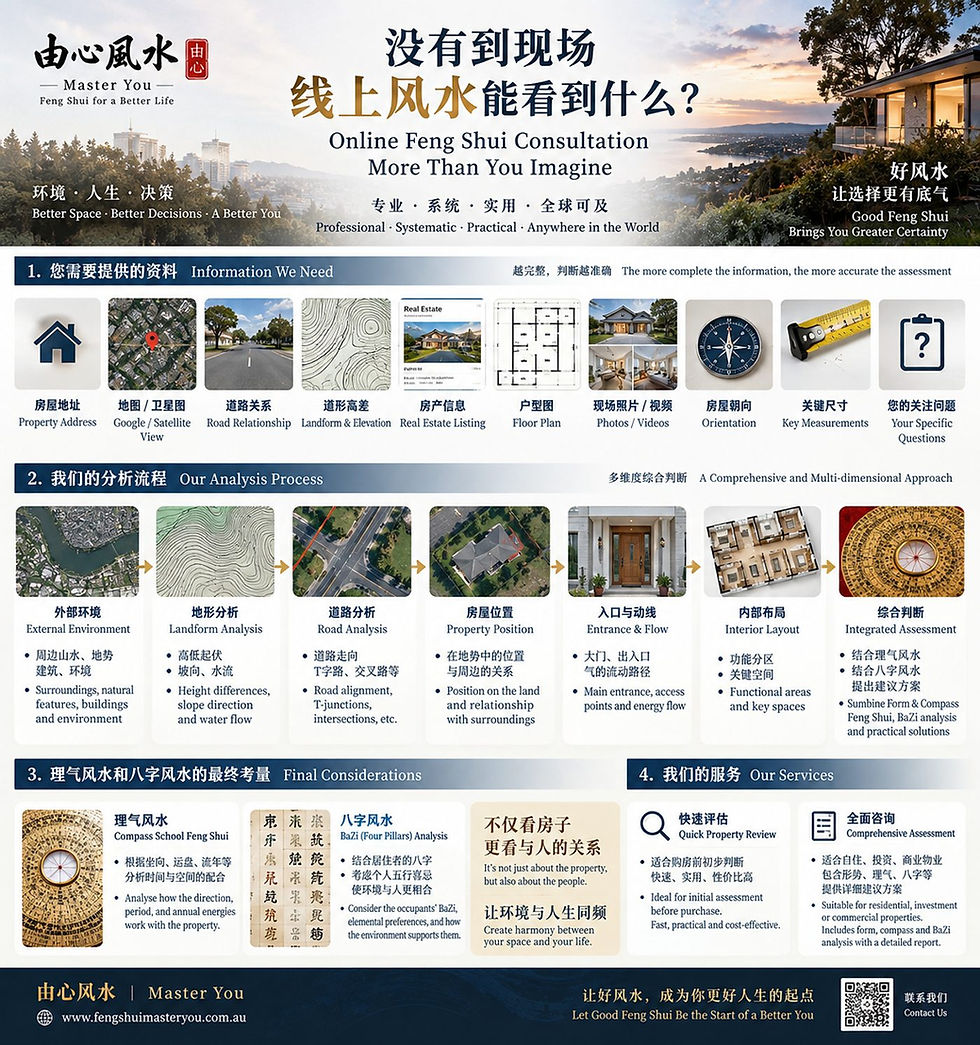
Look at landform and elevation, road alignment, property position, the main entrance, surrounding trees and buildings, and the interior layout. The same T-shape can behave very differently depending on these conditions.
A form is not a verdict
The T-junction is the form. Chong and Xie are descriptions of the relationship created by that form. The better questions are: What is acting on what? Where does the force come from? Where does it go? Is it concentrated inward or dispersing outward?
Design matters
Practical responses may include increasing setback, changing the entrance relationship, using landscape buffers, avoiding a straight interior line through the house, and reviewing drainage, levels and vehicle movement.
When do Compass Feng Shui and BaZi enter?
After the external form, landform, roads, entrance and interior layout are understood, Compass Feng Shui can add direction and timing. Where personalisation is useful, BaZi can add another layer.
If you are considering a property in New Zealand and want a professional review before committing, visit MyFengShui.co.nz.

Comments