


Family Continuity and Cross-Cultural Unison Philosophy
Unison Philosophy · Theory and Practice
How does personal change reach another generation?
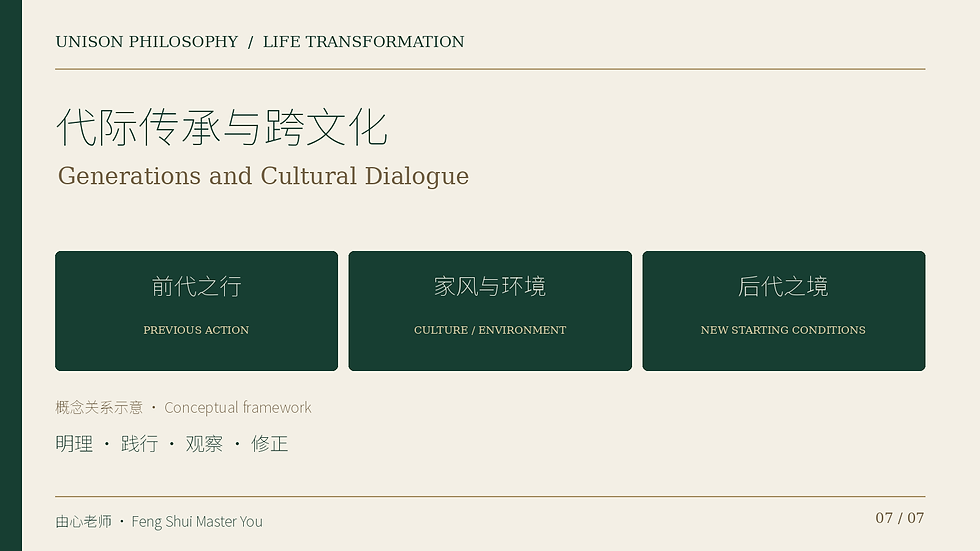
Learning and ethical action do not necessarily produce an immediate change in wealth or housing. Sustained over time, they may contribute to family habits, trust, capacity and resources. A child grows within conditions already shaped by earlier actions.
One generation's actions becoming another's environment is a research direction, not a guarantee. Family difficulties should not be treated as a verdict on ancestors' virtue. Historical conditions, opportunity, environment and individual choice also matter.
What can be recorded?
Reading habits, ways of handling disagreement, care for older people, keeping commitments and use of space can be transmitted through shared life. Education, housing and social networks also shape opportunities, but their effects need a specific account.
In a teaching example, a household protects quiet reading time and provides companionship. Whether a child develops an interest in learning still depends on personal characteristics, school and other conditions. Observation can begin with frequency, participation and changes in experience.
Separate meaning, hypothesis and mechanism
Ancestral homes, remembrance and burial traditions can carry emotional, ethical and cultural meaning. Traditional accounts of virtue, resonance or ancestral Feng Shui may be studied as hypotheses. Observable effects of education or trust do not, by themselves, prove those traditional causal claims.
Describe cultural meaning, traditional interpretation and observable pathways separately. This supports dialogue and avoids turning a complex life into a moral judgement about a family.
Cultural origins and shared questions
The framework's concern with family continuity and self-cultivation connects with East Asian approaches to long-term responsibility. Other traditions also discuss education, charity, home, duty and meaning, while grounding them in different concepts and beliefs. Shared questions can open dialogue without making doctrines identical.
Cross-cultural practice should begin with participants. Some emphasise continuity, others autonomy; some use a religious account, others a secular one. Respect these differences while exploring shared practices such as learning, care, reliability and environmental improvement.
Universality as an open aim
Universal applicability is an aspiration to test, not an established law. Ask whether people from different backgrounds understand a method, choose to participate and find it useful. Adaptation should not remove the freedom to disagree.
The next generation has the right to choose its own life. Continuity should offer better starting conditions and support rather than demand repetition. Unison's long-term direction is to turn personal practice into sustainable family and community conditions while leaving each generation free to learn and revise.
For readers in New Zealand: begin with the actual occupants, property conditions and practical decision you face. Consider the household's needs and the local setting rather than applying a single layout to every home.
Continue the series
Research edition: 11 October 2026. This evolving philosophical and methodological series distinguishes traditional hypotheses from observable mechanisms. Teaching examples are illustrative, not reported client cases.


Comments