


New Zealand Household Recycling: A Family Sorting Guide

Unison Spatial Order Research|由心空间秩序研究 · Part 4
Master You · 15 October 2026 · New Zealand edition
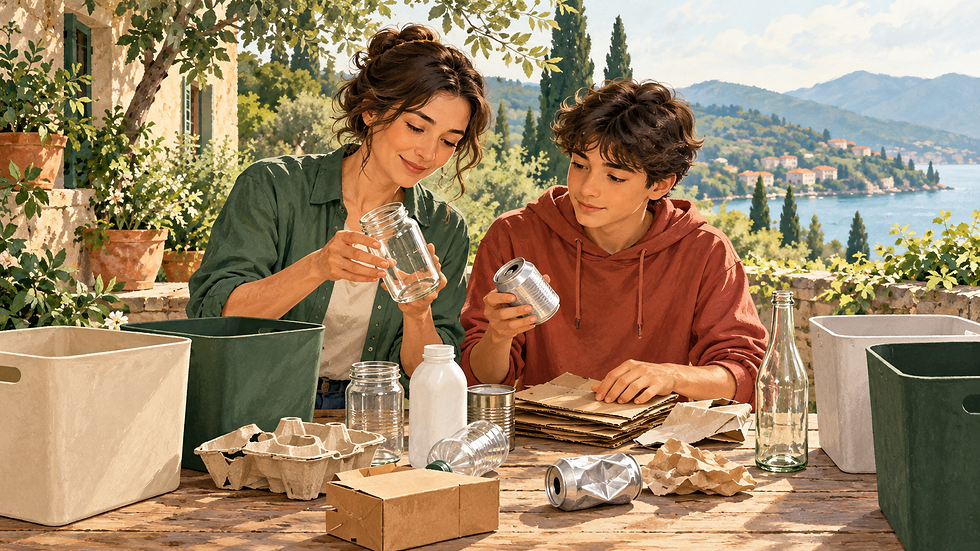
Two objects can look alike and need different disposal routes. Two objects that look different may go into the same collection. That is why sorting starts with a question about the receiving system: what can it actually accept?
A bin colour is a useful local reminder, not a universal rule. A family moving between Australia and New Zealand may bring habits that no longer fit the new collection. Even within Australia, councils operate different services. Begin with the address and provider, rather than a rule remembered from somewhere else.
Start with the official local instructions
This New Zealand edition follows the national household kerbside recycling materials standard, introduced on 1 February 2024. Check your council for the collection service, dates and any separate glass collection at your address; bin colours alone are not enough.
Accepted material groups include paper and cardboard, glass bottles and jars, food tins, drink cans, and eligible plastic bottles and containers marked 1, 2 or 5. Empty and rinse containers, remove lids, and keep excluded small items and other unsuitable packaging out. The official item guidance gives the detailed limits.
Food scraps and garden collections are separate from ordinary recycling and depend on local services. Do not assume that compostable packaging or a green-coloured bin is suitable. Auckland examples should be checked against Auckland Council; elsewhere use the relevant council.
Read an object before choosing a bin
Take a clean, empty food container and ask four questions. What is it? Is it packaging or another household product? Does it have several parts? What does the local guide say about this exact kind of item? A symbol or familiar material name can help your search, but it is not the whole answer.
A glass bottle, a drinking glass and a mirror should not be grouped together merely because all are called glass. Likewise, a plastic toy is not necessarily accepted wherever plastic bottles are collected. Look up the item rather than stretching a general category to fit it.
Make an “ask first” place
When someone is unsure, guessing can pass the problem to the next person in the system. Keep a small, safe “check this” space for clean items while an adult checks the guide. Review it promptly. It should not become an open-ended pile of leaking packaging or hazardous objects.
Batteries, electrical items and chemicals need item-specific advice. Children can help look up information, but adults should handle unsafe waste and arrange suitable drop-off. Do not experiment with broken glass, leaking containers or unknown substances to complete a sorting activity.
Design a sign that helps a real decision
Choose five objects your household regularly uses. Put a clear drawing or photo beside the correct local destination and add one short instruction. Use English and Chinese if that helps your family. Match the meaning, not just the word order, and keep official names recognisable.
Add the council or provider name, the source link and the date checked. A good sign can be updated when services change. Avoid presenting a homemade chart as an official council notice. Ask another person to use it without your explanation; the points where they hesitate are clues for revision.
A family test with useful feedback
For one week, keep an anonymous count of questions about those five items. After putting up the sign, repeat the count. Ask whether the sign was visible from where people made the decision. If someone had to walk across the kitchen to read it, the location may need changing.
Do not search through mixed rubbish for mistakes. Use clean demonstration objects or voluntary questions instead. A small home exercise can show whether a sign is easier to use; it cannot prove a neighbourhood-wide recycling improvement or a precise environmental benefit.
Where the cultural model belongs
Five Elements can invite discussion about materials and change. Unison Ten Dynamics can invite questions about how a sign, bin and user work together. Neither model decides which collection accepts a container. That answer comes from the local service.
This distinction also makes cross-cultural learning more respectful. A relative using the wrong bin may be following a different system, not ignoring the household. Compare the two sets of instructions and explain the difference. Sorting becomes a shared learning task rather than a test of who is a good person.
Start smaller than a perfect household
One reliable decision is a useful beginning. Choose a frequent item, find its current destination, improve the sign and check whether the change helps. You can then add another item without making the whole system difficult to remember.
Research and publication note
Five Elements and Unison Ten Dynamics are traditional-cultural and exploratory research models in this series, not modern material science or validated causal laws. Activities are suggestions, not completed studies or guaranteed outcomes. Illustrations are AI-generated fictional scenes, not evidence from clients or actual participants.
Sources and local checks
Local guidance checked 15 October 2026. Recheck the linked official service before acting; this article is a learning guide, not a council notice.


Comments