


From Rubbish Sorting to a Better Home: How Space Shapes Daily Life
Unison Spatial Order Research|由心空间秩序研究 · Part 1
Master You · 15 October 2026 · New Zealand edition

Taking out the rubbish is the last step in a much longer story. A notebook comes into the house, lands on a table, moves into a drawer and eventually becomes something to keep, share or recycle. When that journey has no clear route, useful things can turn into clutter. This is where Unison Spatial Order Research begins: with ordinary objects and the spaces we share.
Follow one object through your home
Choose something familiar, such as a school bag. Where does it arrive? Where do you unpack it? Where do homework, lunch containers and permission slips go? If the bag is always dropped beside the front door, the problem may be a missing storage place rather than a careless person. A hook within reach, a tray for papers and a space for shoes are possible changes to test.
Draw the route before buying organisers. Include door swings, chairs and the path people actually use. A beautiful storage box is not helpful if it makes the walkway narrower or hides something you need every morning. Start with the room's purpose, then decide what belongs there.
Enough order for the people who live there
An organised home does not have to look empty. Books, artwork and family objects can belong in a well-used room. The aim is to make important activities easier: leaving for school, preparing food, reading, resting and cleaning. Ask each person what they need before deciding that their possessions should disappear.
Sort one small area into keep here, move elsewhere, repair, pass on, recycle and dispose. These are decisions, not permanent labels. A broken pencil case might be repairable; an outgrown book may be useful to another reader. Give temporary groups a next step and a date, so a donation pile does not become a new storage problem.
From a small space to a household habit
Try a ten-minute reset after an activity rather than a large clean-up whenever the room becomes difficult to use. Put the return place close to where an object is used. If every family member struggles with the same cupboard, change the arrangement before assuming everyone needs more discipline.
In Unison's approach to personal and family change, surroundings and habits are studied together. This is a practical research question: does a different arrangement change what people do? It is not a promise that tidying will produce wealth, better grades or good fortune. Time, money, health, family relationships and personal preferences also affect everyday life.
A seven-day family experiment
Choose one drawer or one bag-drop area. On day one, count how many times someone needs help finding an item. Make one agreed change, such as a labelled tray. For the next week, record searches, misplaced objects and whether returning things is easy. Do not change everything at once; you will lose track of what helped.
At the end, ask what worked and what did not. Keep a space for objects that need a decision, but review it regularly. A useful result might be modest: fewer papers on the dining table or a clearer entrance. If nothing improves, record that too. An honest observation is more valuable than an impressive before-and-after photograph.
Your local recycling destination
This New Zealand edition follows the national household kerbside recycling materials standard, introduced on 1 February 2024. Check your council for the collection service, dates and any separate glass collection at your address; bin colours alone are not enough.
Food scraps and garden collections are separate from ordinary recycling and depend on local services. Do not assume that compostable packaging or a green-coloured bin is suitable. Auckland examples should be checked against Auckland Council; elsewhere use the relevant council.
A question to take into the next room
Instead of asking only, “How do I get rid of this?”, ask, “What role does it have now, where should it go next, and who needs to agree?” Spatial order grows from these small, shared decisions. You can explore the next step in this series by comparing an object's material, cultural interpretation and real disposal route.
Research and publication note
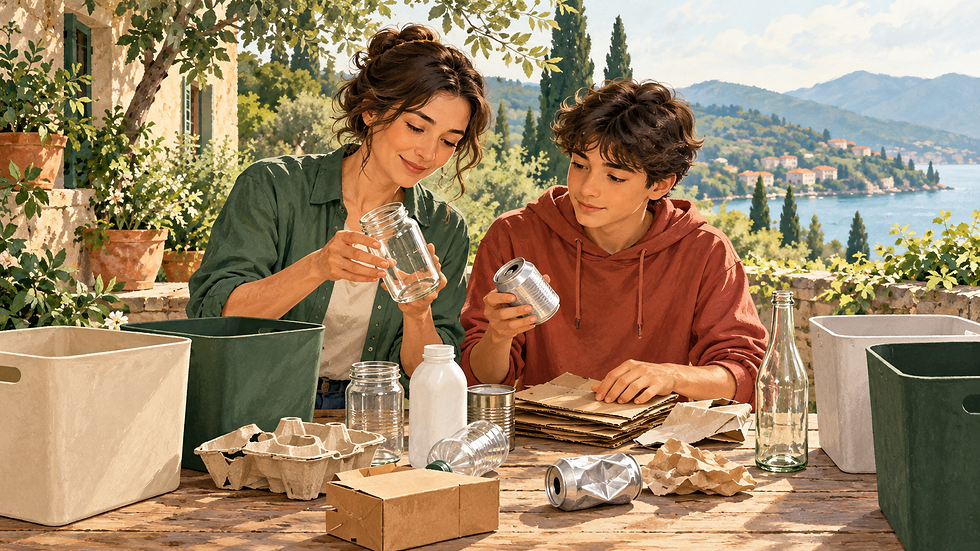
Five Elements and Unison Ten Dynamics are traditional-cultural and exploratory research models in this series, not modern material science or validated causal laws. Activities are suggestions, not completed studies or guaranteed outcomes. Illustrations are AI-generated fictional scenes, not evidence from clients or actual participants.
Sources and local checks
Local guidance checked 15 October 2026. Recheck the linked official service before acting; this article is a learning guide, not a council notice.


Comments